Should You Remove or Save a Tree? A Huntsville Homeowner’s Guide
Not sure whether you should remove or save a tree? A tree can look damaged without needing to come down, while another tree may appear healthy but have structural problems that make it unsafe to keep.
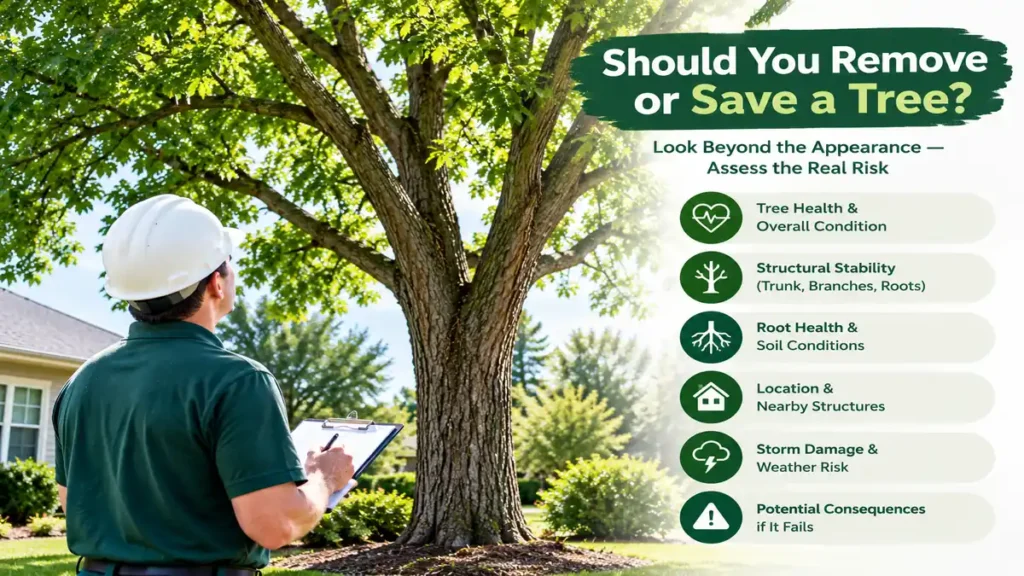
The right decision depends on the tree’s condition, structural stability, root health, location, and the potential consequences if part or all of the tree fails.
If you’re unsure whether a tree should be preserved, pruned, monitored, or removed, start by assessing the actual risk rather than making the decision based on appearance alone.
When Should You Save or Remove a Tree?
A tree may be worth preserving when it is generally healthy, structurally stable, and can be safely managed through pruning, monitoring, or other appropriate care.
Removal may become the better option when a tree has severe structural damage, major root failure, extensive decline, or a level of risk that cannot reasonably be reduced.
The location also matters. A tree with a defect in an isolated part of a property presents a different risk from a similarly damaged tree beside a house, driveway, vehicle, or frequently used area.
Start With the Tree’s Overall Condition
Before deciding what to do, look at the tree as a whole rather than focusing on one visible defect.
Consider:
- Overall health and vigor
- Amount of live foliage
- Dead or declining sections
- Trunk condition
- Major branch structure
- Root condition
- Lean or movement
- Signs of decay or damage
- Recent storm damage
- Changes from previous seasons
One problem does not automatically mean a tree should be removed. The severity, location, and combination of problems matter.
Tree Health and Long-Term Viability
A healthy tree with a manageable defect may have many years of useful life remaining.
Signs that may support preservation include:
- Strong overall growth
- A healthy canopy
- No major trunk defects
- Stable root system
- Limited deadwood
- No significant structural failure
- Problems that can be addressed through appropriate maintenance
On the other hand, extensive decline, repeated major damage, severe decay, or declining structural stability can change the decision.
The goal is not simply to determine whether a tree has a problem. It is to determine whether that problem can be reasonably managed.
Structural Problems That Deserve Closer Attention
Some defects deserve more attention because they can affect the tree’s structural stability.
Major Trunk Cracks
Large cracks or splits in the trunk can indicate structural weakness, particularly when they extend through important parts of the stem.
Weak Branch Unions
Branches with weak or poorly formed connections can be more vulnerable to failure, especially when they are large or exposed to additional stress.
Major Root Problems
Roots provide both support and access to water and nutrients. Significant root damage, soil disturbance, exposed roots, or root failure can affect stability.
Significant Leaning
A natural lean is not automatically dangerous. However, a new or worsening lean, particularly when combined with root disturbance or ground movement, deserves closer attention.
For a broader explanation of how tree risk is evaluated, the Alabama Cooperative Extension System explains factors such as the likelihood of failure and what could be affected if a tree or branch fails.
When Pruning May Be Enough
Removal is not always the first solution.
Pruning may be appropriate when the problem is limited to specific branches and the tree remains generally healthy and structurally stable.
Examples can include:
- Dead branches
- Broken limbs
- Overgrown branches
- Branches interfering with a structure
- Minor clearance problems
- Limited canopy defects
The objective should be targeted pruning rather than removing more live growth than necessary.
For routine maintenance concerns, professional tree trimming and pruning may be a better approach than complete removal.
When Monitoring May Make More Sense
Some tree problems do not require immediate action.
Monitoring may be reasonable when:
- The tree is generally healthy
- The defect is minor
- There is no obvious sign of structural failure
- The condition is stable
- There is limited exposure to people or property
Monitoring should not mean ignoring the tree. Changes in cracks, lean, deadwood, root conditions, or canopy health can alter the risk over time.
If the condition changes, reassess the tree rather than relying on the original decision.
When Removal Becomes the Better Option
Removal may become appropriate when the tree has a serious problem that cannot reasonably be managed.
Examples can include:
- Severe structural failure
- Major trunk damage
- Significant root failure
- Extensive decline
- A dead tree in a high-use area
- Severe storm damage
- A tree that presents an unacceptable risk to nearby people or property
- A condition that cannot be effectively reduced through pruning or other management
The decision should be based on the actual condition and circumstances rather than fear alone.
If removal is determined to be the appropriate solution, see our tree removal service in Huntsville for more information about the removal process.
The Location of the Tree Can Change the Decision
The same tree defect can have very different consequences depending on where the tree stands.
Consider what is within the potential fall or branch-drop area:
- Home
- Garage
- Vehicle
- Driveway
- Fence
- Patio
- Walkway
- Neighboring property
- Frequently occupied outdoor area
A tree in an open part of a property may present fewer consequences if it fails than a similarly damaged tree beside a home, driveway, vehicle, or frequently used area.
In Huntsville, the surrounding property should be considered alongside the tree’s condition, structure, and growing environment.
Do You Need Permission to Remove a Tree in Huntsville?
Tree removal requirements can depend on where the property is located and whether the tree is on private property or within a public right-of-way.
The City of Huntsville’s Urban Forestry & Horticulture division administers the city’s tree ordinance. Requirements can therefore differ depending on the location and circumstances of the tree.
For properties in unincorporated Madison County, separate county permitting and zoning requirements may apply.
Before scheduling removal, homeowners should confirm whether any local approval applies to their specific property—particularly if the tree is located near a public right-of-way, easement, development project, or other regulated area.
Do not assume that every private-property tree removal requires the same approval. Check the applicable local requirements before beginning work.
What About a Tree Near Your House?
A tree does not automatically need to be removed simply because it is close to a house.
The important questions are:
- Is the tree healthy?
- Is the trunk structurally sound?
- Are major branches stable?
- Are the roots supporting the tree properly?
- Is the tree leaning toward the structure?
- Could a failure affect the roof, walls, driveway, or another important target?
A healthy tree near a house may be manageable with appropriate maintenance.
A damaged or unstable tree in the same location can present a much different risk.
What About Storm-Damaged Trees?
Storm damage can make the decision more difficult because problems may not be obvious from the ground.
Look for:
- Broken major limbs
- Split branches
- Cracked trunks
- Uprooted or lifted roots
- Sudden leaning
- Hanging branches
- Large sections of damaged canopy
Do not climb or cut a storm-damaged tree yourself if the tree is unstable or branches are under tension.
If a damaged tree is threatening a home, vehicle, driveway, or another occupied area, treat the situation as urgent. Our emergency tree service page explains what to do when storm damage creates an immediate tree hazard.
What If the Tree Is Healthy but You Do Not Want It?
Health and risk are not the only reasons a homeowner may consider removal.
You may dislike the tree because it:
- Blocks a desired view
- Interferes with planned landscaping
- Creates excessive shade
- Drops unwanted debris
- Conflicts with a construction or property-use plan
- Has outgrown its location
A healthy tree should not automatically be classified as hazardous simply because it is inconvenient.
Before removing it, consider whether pruning, relocation of the planned use, or another property-management solution could address the concern.
If removal is still the preferred option, the decision should consider access, surrounding structures, the tree’s size, and the safest method of removal.
Choosing the Right Tree Care Approach
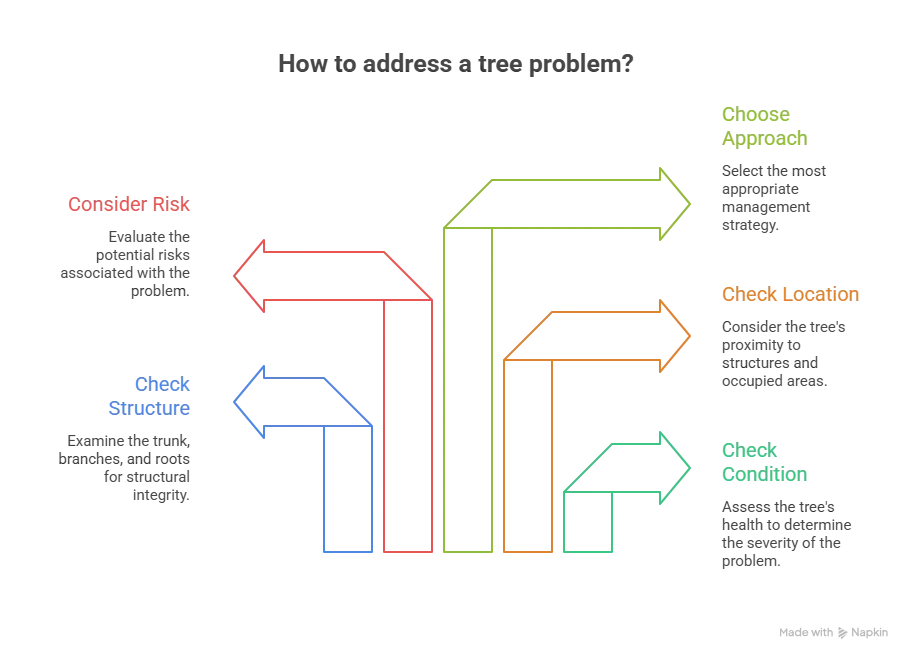
Not every tree problem calls for the same response. The right approach depends on what part of the tree is affected, how serious the problem is, and whether the condition can be managed safely.
| What You’re Dealing With | A Reasonable Starting Point |
|---|---|
| A few dead or unwanted branches | Selective pruning |
| Branches interfering with a roof or driveway | Clearance pruning |
| A tree that is generally healthy but needs maintenance | Routine tree care |
| A minor defect that is not getting worse | Monitor and reassess |
| A large damaged limb that cannot be safely managed from the ground | Professional evaluation |
| Significant damage to the trunk or major stems | Professional evaluation |
| Root disturbance combined with instability | Prompt professional evaluation |
| A dead or severely declining tree in a high-use area | Removal may be appropriate |
| A tree with severe structural failure | Removal may be appropriate |
| A tree that cannot be reasonably stabilized or managed | Removal may be appropriate |
The purpose is not to choose removal first. It is to determine whether the problem can be pruned, managed, monitored, or safely resolved through removal.
What a Professional Assessment Should Consider
A useful assessment should look beyond the most obvious defect.
Important factors include:
- Tree species and overall condition
- Trunk structure
- Major branch attachments
- Deadwood
- Cracks or splits
- Root condition
- Lean and stability
- Recent storm damage
- Surrounding structures
- Potential targets
- Access to the tree
- Consequences of failure
- Whether pruning or another management option could reduce the concern
This helps separate a tree that needs maintenance from one that presents a more serious structural problem.
Avoid Making the Decision Based on Fear Alone
Seeing a large crack, dead branch, or leaning tree can be alarming.
But removing every tree with a visible defect is not necessarily the right approach.
A better decision considers:
Condition + Structure + Location + Likelihood of Failure + Consequences
This gives you a more practical basis for deciding whether the tree should be maintained, monitored, professionally assessed, or removed.
Frequently Asked Questions
Yes. A healthy tree may still be removed because of property use, construction plans, severe location conflicts, or other legitimate reasons. However, health and safety should be considered before deciding.
No. Some trees naturally lean and remain stable. A new or worsening lean, especially when combined with root movement, soil disturbance, cracks, or other structural problems, deserves closer attention.
Sometimes. Limited branch damage may be addressed through appropriate pruning, while more severe trunk, root, or structural damage can make removal necessary. The extent and location of the damage matter.
Not automatically. A healthy, stable tree may be manageable even when close to a structure. A damaged or unstable tree in the same location can present significantly greater consequences if it fails.